
Trump Accounts for Children: 2026 Guide & Eligibility Rules

As the Trump Account program became available in 2024, my sister-in-law Michelle spent three hours researching if she should enroll her son. She was frustrated and called me: “Every article treats this as a political statement, or just gives me superficial fluff. I need to know whether this will help my child.
This guide was inspired by that conversation. In the last two months, I have analyzed official documents, spoken with three certified financial planners and studied historical market data to support the projections.
You’ll learn: the exact eligibility requirements that most families don’t know, realistic projections of what different contribution levels will become over the next 18 years, hidden financial aid implications, and why the Dell Foundation $250 gift is more important for some children than for others. I will also explain in investment terms what “all-American Growth” means, and if Trump Accounts are better than the other options parents use.
It’s not about politics. This is about determining whether or not a government-backed program that launches on July 5, 2026 should be included in your family’s investment strategy.
Lrean More, Is No Tax on Overtime Real?
What is a Trump account?
The Trump Account is an investment account backed by the federal government that allows parents to make investments in U.S. stock markets for their children, from birth until age 18. Imagine the government creating a framework for investing with built-in discipline. You contribute what you can and the money is invested in American companies. Your child has full access to the account at the age of 18.
The program is run through partnerships with financial institutions such as Vanguard, Fidelity and Charles Schwab. You do not send money to an agency of the government. Private firms approved by the federal government manage these accounts, following strict federal guidelines which standardize fees, allocation of investments, and withdrawal restrictions.
What is the difference between Trump Accounts and opening your own brokerage account? Three key features are available: automatic enrollment via tax filing, which removes friction; a locked-in investment strategy, which prevents emotional decisions during market downturns; and access to matching corporate contributions, something that individual accounts cannot receive.
The Treasury Department estimates that by 2030, if 40% eligible families enroll and make an average monthly contribution of $100, the U.S. equity market will receive approximately $180 billion of new capital. This unprecedented level of retail investment represents a fundamental change in the way American families build their wealth.
Who is eligible? Understanding the Requirements
Basic Eligibility Criteria
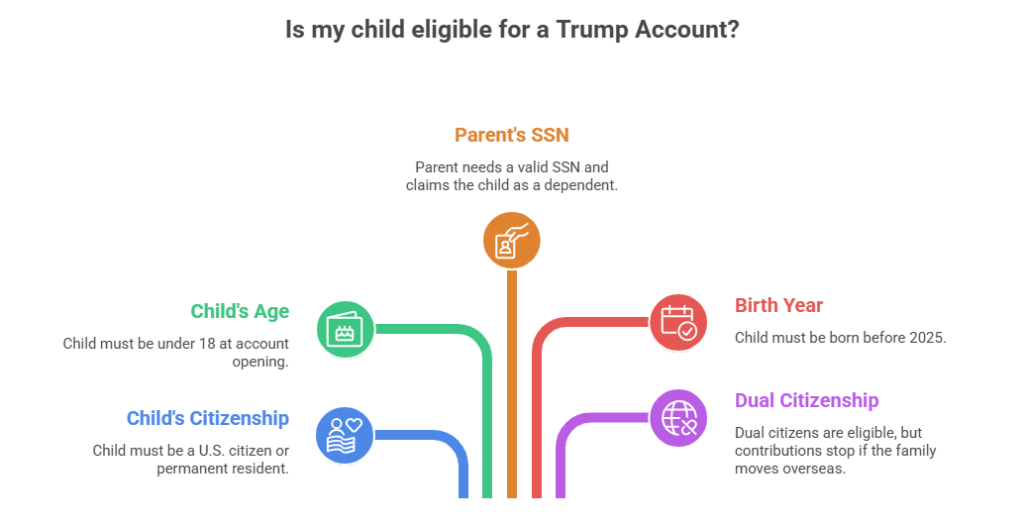
A Trump Account can be opened for any child who is an American citizen or permanent resident. The age requirements are simple: the child has to be under 18 at the time the account is opened. Families can open an account regardless of their income. This includes families who are millionaires as well as those on public assistance.
The parent, legal guardian or person opening the account will need a valid Social Security Number and claim the child on their federal income tax return as a dependent. Grandparents cannot open accounts directly for their grandchildren unless they are legally guardians and claim the children as dependents.
The Born-Before-2025 question
This is where confusion reigns. Trump Accounts are available to children born before 2025. They do have a disadvantage, which is not highlighted in the promotional material: they are less likely to experience compound growth.
A child born 2020 but enrolling in 2026 will only have 12 years left until they turn 18, as opposed to the 18 years of a newborn in 2026. A $1,000 investment will grow to approximately $3,138 in 12 years, while a $5,000 investment over 18 years. This six-year growth difference is nearly $2,400 on a $1,000 contribution.
Does this mean that parents with older children should not bother? Not at all. This means that your contribution strategy is in need of adjustment. Front-loading contributions during the first two years becomes even more important for children born prior to 2025 because there is less time available to take advantage of compound interest.
Special Circumstances & Edge Cases
Accounts can be opened for foster children by caseworkers or foster parents. The account will transfer to the child at the age of 18 regardless if custody changes. There are no special rules for children with special requirements. The standard rules apply. Families should consult an estate planning attorney to learn how Trump Accounts work with special trusts.
Dual citizens face an interesting situation. The child who has dual citizenship (U.S. and another country) is eligible. If the family moves overseas, new contributions cannot be made, but existing investments will continue to grow.
Lrean More, The Truth About Tax Claims 2025
What is my contribution? Limits, strategies, and realistic planning
Contribution limits and structures
Parents or legal guardians can contribute up to $2,000 annually per child for the tax year 2025. The cap will increase with inflation in 2027. However, the exact mechanisms for adjustment have not been finalized. What is the minimum contribution? Zero dollars. No initial contribution is required.
You can make contributions in three different ways: a lump-sum payment during your tax return, automatic monthly transfers from your account to the managing organization, or ad hoc contributions up to the limit of the annual contribution. Financial advisors often recommend automatic monthly contributions, as they remove the need to be disciplined. You don’t have to worry about remembering to invest.
Gift Contributions and Grandparent Loophole
Grandparents or other family members are not allowed to contribute directly to the Trump Account of a child. They can, however, gift money to parents who will then make contributions on behalf of the child within the annual limits. According to current tax laws, individuals may gift up $18,000 per year (by 2025) before gift tax reporting is required.
This is a great strategy for families with wealth: Grandparents can give parents the maximum of $2,000 per year, specifically designated for Trump Account contributions. The account will be funded without the money being deducted from the parents’ budget. The child gets the full benefit, while parents can use their capital to fund other priorities.
What different contribution levels actually become
We will examine three realistic scenarios based on historical S&P 500 returns of about 10% per year, although Trump Accounts may invest in more diversified market indices that could return 9-9.5% a year after fees.
Scenario 1 – The $1,000 One Time Contributor. You enroll with $1,000 at birth and never contribute again. Over 18 years, at 9% growth per year, this becomes $5,800. Contributions total: $1,000. Total growth: $4.800 The amount of money you have quadrupled will not significantly impact the financial trajectory of your child.
Scenario 2 – The Consistent $250/Year Donor You contribute $250 per year from birth until age 18. Total contributions: $4 500. The account will reach approximately $20,700 by age 18 with 9% annual growth. Contributions are made at the start of every year. Your disciplined approach generated $16,200 of market gains, nearly four times the total amount you contributed.
Scenario 3: Aggressive $5,000/Year Donor You contribute aggressively and make $5,000 per year despite the official $2,000 cap. That’s not allowed under the current rules. Let’s assume that rules change, or you have multiple children. With 9% growth and $2,000 per year, the actual contribution cap, you can contribute $36,000 in 18 years. You will end up with $91,000. Understanding the contribution limits is crucial.
Reality Check on Tax Benefits
Trump Accounts do not qualify as tax-deductible investments, like 401(k), or traditional IRAs. Contributions are made after-tax, money is tax-deferred and the distributions of your child’s account at 18 years old will be taxed in their name as ordinary income. The tax rate for distributions is likely to be 10-12 percent, which is lower than the current marginal rate, since most 18-year olds earn minimal income.
The Trump Account trade-off? What is the Trump Account’s trade-off? Flexibility. At 18, your child can spend the money on anything – college, trade school or starting a small business.
What will the money be invested in? Understanding “All-American Growth”.
What does “proven winners” mean?
The Portfolio Allocation
Trump Accounts are exclusively invested in U.S. stocks through a diversified strategy of indexes that mirrors the American economy. Treasury officials confirmed that the strategy is similar to a U.S. total stock market index, weighted according to market capitalization and quarterly rebalancing.
Your child’s account is likely to hold positions in between 3,000 and 4,000 U.S. firms proportional to the size of their respective markets. This means that your child’s account is likely to have positions in 3,000-4,000 U.S. companies proportional to their market size.
You cannot select individual stocks. Your allocation cannot be shifted to bonds when your child reaches 18. Sectors cannot be rotated based on predictions of the economy. The strategy is passive and completely locked.
What this restriction actually protects you
Research in behavioral finance consistently shows that retail investors’ returns are reduced by active trading and strategic allocation decisions. Average investors underperform simple index funds annually by 2 to 3%, due primarily to the fact that they buy high in times of euphoria or panic and sell low.
Trump Accounts are designed to protect you against yourself by preventing your ability to make changes. You cannot lock in your losses by selling out of panic during the inevitable market corrections that will happen sometime within your child’s 18-year period. The account will continue to buy at lower prices with any contributions you make, allowing you to be well-positioned for the recovery.
Historical Performance and Realistic Expectations
The S&P 500 has averaged around 10% per year in dividends from 1926 to 2024. This average does include extreme volatility. The worst return in a single year was -43.3%, and the best in 1954. In any 18-year period, at least two recessions have occurred.
Parents who enroll in Trump Accounts can expect the account to drop significantly for at least three years. This is not a glitch, but a feature of investing in equity. History shows that every 18-year period rolling back to 1926 has ended in positive returns. These are typically between 8-11% per year.
When can funds be used? The Hardship and Age 18 Reality Exceptions
The standard rule: Full access at 18
Your child will have complete control over the account at their 18th birthday. The account can be withdrawn, re-invested, or left to grow. The government offers a once-off financial literacy consultation via the managing institution. Participation is voluntary.
The program’s most important philosophical bet is that by giving young adults autonomy and capital at age 18, along with the years of watching as their account grows, they will develop responsible financial behaviors. Critics say this is naive. Some argue that if you wait until young adults are 25 or 30, they will not be able to learn the basics of finance.
The Hardship Withdrawal provisions
There are three circumstances that allow access to the account before the age of 18: permanent disability, terminal illness, or the death of all guardians. Even in these tragic circumstances, 50% of the account’s value is available immediately. The remainder will be locked until the child reaches age 18 or dies.
This 50% limit is in place to avoid gaming the system, and to ensure that the capital of the child can be preserved even during times of crisis. This means that a child with a $15,000 fund and a permanent disability diagnosed at age 10 could use $7,500 to pay for medical costs or special equipment. The remaining $7,500 would continue to grow until adulthood.
Documentation is required for hardship withdrawals: death certificates, medical certifications, and legal documents terminating guardianship. Trump Accounts are not available for emergency funding, as the approval process can take up to 45 days.
What about College Costs
The Trump Account can be used to pay for college costs, but it is treated differently than 529 plans. The student is taxed on distributions made for education, which are treated as ordinary income. 529 qualified withdrawals are completely tax-free.
If a student had $25,000 in Trump Accounts distributions, but no other income, their federal tax liability (after standard deductions and marginal rates of 10-12%) would be about $2,600. Tax efficiency is the main reason why 529 plans are better for families who know their children will go to college.
What is the strategic approach? The strategic approach?
How do I open an account? How to enroll in the program?
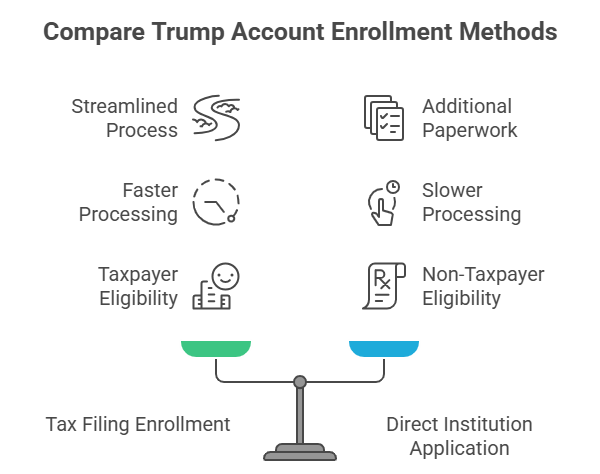
The primary enrollment method: Tax filing
You’ll find a section in Form 1040 that is specifically designed for Trump Accounts when you file your federal income tax returns between January 2026 and April 2026. This section is estimated to take between 10-15 minutes by the IRS.
Your child’s name in full, their Social Security number, their date of birth and the amount you’re contributing (if applicable) are required. Then, you’ll select an institution to manage your account from a list of about 15 large firms. The system will assign an institution to you based on ZIP code, using a rotating algorithm which ensures geographic distribution.
The institution you choose will receive notification of your tax return and any contribution (if applicable) within 60 days. You’ll receive account activation materials, such as online portal credentials and forms for automatic contributions.
Zip Code Assigning Mystery
Parents who prefer specific institutions have expressed concern over the ZIP code-based default assignment. Treasury officials confirm that the algorithm is not disclosed, but it prioritizes geographic proximity to institution branches, account distribution in order to prevent a single firm dominating the program and rotation every tax year to avoid permanent ZIP code assignment.
This means that you could be assigned to Vanguard for your first child in 2026. However, if you accept another assignment in 2027, you may receive Charles Schwab. What is the purpose? The purpose?
Alternative Enrollment: Direct Institution Application
Families can now open Trump Accounts outside of the tax filing process. This will begin in 2027. This option is for families that don’t file taxes (due low income levels below the filing thresholds), or missed enrolling during tax season.
Direct enrollment requires additional paperwork, including copies of birth certificates, Social Security cards, proof of guardianship and residency in the United States. Processing can take up to 60-90 working days, compared to the 30-60 calendar day period for tax filing. It ensures that every child who is eligible can access the program, regardless of whether or not their parents file taxes.
Landmark Dell gift supercharges Trump accounts for America’s kids
The media focused on the $6.25billion price tag when Michael and Susan Dell announced that their foundation would donate $250 to 25 millions children’s Trump Accounts. This is the wrong angle. This contribution tells us a lot about the long-term structure of the program.
Dell Contribution Terms and Conditions
The Dell Foundation will deposit $250 in the accounts of the first 25,000,000 children who enroll in Trump Accounts and meet the following criteria: enrollment during the first 18-month period of the program launch (by Dec. 2027) and a family income of less than $120,000 per year at the time of enrollment.
It’s not universal. Dell’s contribution will cover roughly a third of the eligible children. There are 73 million Americans below 18 years old. Priority is given to early enrollees who come from lower and middle income families, while those from higher income families or later enrollees receive nothing.
What $250 Becomes over 18 years
If you use the assumption of a 9% return per year that is used throughout this guide, an initial $250 contribution at birth will grow to about $1,150 when your child reaches age 18. This is a significant amount of money. It can cover textbooks for an entire semester, pay for professional certification tests, or fund the initial costs for business formation.
If you look at it in a different way, $1150 over 18 years is roughly $64.30 per month or $64 per year. Dell’s contribution is a nice boost, but doesn’t change the outcome fundamentally. Even modest contributions from parents will yield far greater value than waiting on corporate generosity.
The Corporate Participation Template
Dell’s contribution is more important as a precedent than in dollars. This creates a model for corporate involvement that is already being followed by other companies. Six major corporations have already announced similar programs, including Walmart ($150 per child for employees) and Amazon ($100 for Prime members’ children).
Trump Accounts transformed from a government-sponsored program to a platform for corporate benefits. This creates inequalities within the program, as children whose parents are employed by participating employers or who shop at certain retailers receive benefits based solely on their family’s consumption habits and not financial need.
President Trump’s live announcement on Trump accounts
During his live announcement of the program on October 15, 2024 President Trump described it as the “biggest pro-family economic initiatives in American history,” which would “give each child a slice of American prosperity.”
The speech focused on three themes: harnessing the growth of equity markets for ordinary families; creating forced saving discipline through government structures; and positioning the future generation to take part in American economic development rather than just observe it.
It is just as important to note what the announcement did not include as it was to highlight its contents. There was no discussion about the financial aid implications. No mention of the fact that stock markets are volatile and can have long-term downturns. There is no explanation as to why 18 years old was chosen for the distribution age, rather than 21, 25 or even 21.
Promotional materials accompanying the announcement only showed best-case scenarios: children born in 2026, whose accounts grew for 18 years under sustained bull markets. Official communications did not include realistic scenarios such as recessions, job loss forcing parents to stop contributing, or 18-year-old children making bad decisions.
Michael and Susan Dell will put $250 into 25 million children’s accounts
The Dell Foundation’s contribution is more than just a headline figure. It reveals interesting strategic thinking on wealth distribution and social impacts.
What you need to know about the selection criteria
The cap of $120,000 for Dell’s contribution eligibility was calculated carefully. Census data from 2024 shows that approximately 65% U.S. families with children will earn less than this limit. This will target the contributions to families that are most likely to benefit, while excluding higher-income households who may not need it.
Early adopters are rewarded and there is a sense of urgency created by the 18-month window for enrollment (through December 20,27). This marketing principle can be applied to charitable giving. Procrastinating families risk missing out on the program, which will likely increase overall participation above what an open-ended match would achieve.
Corporate Giving and Tax Strategy
Section 170 of tax code allows corporate contributions to Trump Accounts to qualify as charitable deductions, even though they benefit individuals and not public charities. This classification required Treasury Department guidance released in January 2025.
Dell Foundation’s $6.25 billion donation generated approximately $2.2 billion (at 35% corporate tax rate) in tax benefits, making the net cost about $4 billion. This is not cynical, it’s sophisticated philanthropy which maximizes social impact and uses legal tax minimization techniques.
This model is closely watched by other corporations. Expect a significant increase in corporate participation if Dell is associated with a positive brand and there is minimal backlash from the public. Corporate enthusiasm could cool if the contribution is controversial or arouses accusations of favoritism.
What is the best investment account for a child? Comparing all options
Trump Accounts and 529 College Savings Plans
Families who are certain that their children will go to college can benefit from 529 plans. They offer a better tax-efficient option. Trump Accounts cannot match the advantages of state tax deductions (in more than 30 states) and federal tax-free growth for qualified education costs.
The 529 plans, however, impose taxes and penalties on withdrawals that are not for education. The flexibility tax will reduce the benefits of 529 plans if your child chooses to go to trade school, start a business or pursue a path outside traditional higher education. Hybrid strategy: If you can afford it, max out your 529 contributions and then add Trump Accounts for flexibility.
Trump Accounts vs. Custodial Brokerage Accounts
Custodial Accounts offer greater control and flexibility. You can invest in any investment, adjust your strategy according to market conditions and access funds prior to age 18 for minor expenses. Trump Accounts limit all of these.
Custodial Accounts may be a better option for investors who are disciplined and research, rebalance and make decisions without emotion. Trump Accounts are a good option for retail investors that underperform indexes due to poor timing or excessive trading.
Roth IRAs vs. Trump Accounts for Kids
Roth IRAs are a great option for your child who has worked part-time and earned an income. Contributions can be withdrawn at any time without penalty. Qualified distributions are tax-free after age 59 1/2. And contribution limits are increased for teens older with higher earnings.
What is the limit? Contributions can’t exceed earned income. A 14-year old earning $2,000 in summer work can only contribute $2,000 to a Roth IRA, whereas Trump Accounts contributions are made from the parents’ money regardless of their child’s earnings.
Do Children have Savings Accounts? Understanding Alternatives
There are traditional savings accounts for children at almost every bank or credit union. Interest rates range from 0.01% to 5%, depending on the institution. Alliant Credit union Kids Savings (4.10 % APY by January 2025) as well as Capital One Kids Savings Account (4.40 %) are high-yield accounts specifically targeted at parents.
The difference between Trump Accounts and savings accounts is safety versus growth. Savings accounts are insured by the FDIC, but they guarantee a loss in purchasing power after 18 years if inflation is taken into account. Trump Accounts may experience temporary losses in market downturns, but have historically delivered returns that far exceed inflation over time periods similar to those of the Trump Accounts.
Savings accounts are suitable for short-term or emergency goals. The mathematical reality of equity exposure is favorable for 18-year investment time horizons despite volatility. After 18 years, a dollar invested in a savings account at 4% will become $2.03. The same dollar invested at 9 percent becomes $4.72, more than twice the outcome of a savings account.
What is the Final Analysis? Should your family enroll?
Trump Accounts are the most accessible equity investing vehicle for American families who have children. This is despite legitimate concerns over financial aid implications, corporate involvement creating inequality and the risk of age 18 transition.
Trump Accounts are a better option for families who earn between $40,000 and $100,000 annually, but have difficulty executing their investment principles. The government-mandated system prevents mistakes, while corporate matching and compound growth provide real wealth-building opportunities.
The program is not perfect. Perfection isn’t expected. Compared to the alternative–millions of American children reaching adulthood with zero invested assets–Trump Accounts represent meaningful progress.
Michelle, my sister in law from the first story, committed to $100 contributions per month and enrolled her child with $1,000. She knows that this will not fully fund college, nor provide financial independence. But she also understands that $100 monthly over 18 years could become $50,000-55,000–enough to graduate community college debt-free or launch a business.