
Trump Child Support Law: The Truth About Tax Claims 2025
My phone began to buzz with panicked messages from divorcing parents three weeks before Donald Trump’s January 2025 inauguration. Did you see the new laws? One client texted another at 11 PM. “I’m going to lose my tax refund because I put his child support on.”
There was no law. There was no law.
What I saw was a TikTok clip spreading panic like wildfire in communities of single-parents and blended families. The claim was specific, simple and completely false: Trump signed a bill that prevents parents who receive child maintenance from claiming their kids on tax returns.
The damage had already been done by the time the creator of the video admitted that he made it up in 2025. The misinformation had led to thousands of parents adjusting their financial plans. Some parents stopped the enforcement of child support. Some panicked at the thought of losing their tax credits.
Since I have been practicing family law for 12 years, I have never seen so much misinformation or confusion spread. Let’s get to the facts and clear up any confusion about child support and tax laws, as well as who can claim their children as dependents.
Lrean More, our Complete 2026 Guide to Building Tax-Free
What Really Happened? The Viral Lies That Fooled Thousands
William Elston, a TikToker who posted a video mid-January 2025 in which he claimed that Trump tweeted about a policy change. The false claim claimed that parents who put the other parent of their child on child support automatically lost the right to claim the child on their tax returns. The tax benefits are only available to the parent who pays child support.
The video was popular because it touched on real anxieties. Many parents who have custody worry about their financial security. Many non-custodial parent feel that the system is unfair. The fake law appeared to address both concerns, while creating a new and devastating problem.
On Instagram, Facebook and Reddit, users spread the claim with different variations, claiming that Trump announced it on his X-account. In some versions, it was added that the message was specifically aimed at women who receive child support. Some versions claimed that it was applicable to all women receiving child support.
Elston confessed later, on 21 January 2025: “I made this up. It’s fake. “He didn’t get anything.” By then, however, the misinformation was embedded in thousands of conversations and confusion still persists today.
There is no Trump Child Support Tax Law
I want to be clear about this: Under Trump or any president, there has never been a rule that prevents child support payers from claiming their dependents as children.
I checked all the sources. No executive order, congressional bill, IRS update, or court ruling gives the parent paying child support the automatic right to claim the child when filing their taxes.
Trump’s legislative record in family tax matters is the Tax Cuts and Jobs Act, which doubled Child Tax Credits from $1,000 to $2000 per child. This law did not change the rules for who can claim children based on payments of child support as dependents.
The One Big Beautiful Bill Act of 2025, passed by Congress in the year 2025, increased the Child Credit to $2.200. It also made changes to the refundability thresholds as well as to requirements for Social Security numbers. The One Big Beautiful Bill Act of 2025 did not alter dependency rules, nor create any link between child support payments or tax claims.
Politifact and Snopes investigated the claim in depth. Google News and Nexis database did not yield any credible reports that Trump had proposed or passed such a law. Trump’s X page also contained no posts regarding a purportedly new policy.
IRS rules that haven’t changed: How tax dependency actually works
Internal Revenue Service rules have been in place for decades about who is eligible to claim a child under the dependent status. These rules haven’t changed for decades and are based on child custody arrangements rather than child support payments.
The Custodial Parent Has First Rights
The custodial parent is the parent who has the child for the most nights in the past year. The custodial parent is the one who has the right to claim their child as a dependent and to receive tax benefits, such as the Earned income Tax Credit and Child Tax Credit.
The IRS does not care who pays child maintenance. The IRS is concerned about the place where the child sleeps.
Last year, I represented a customer who paid $2400 per month in child support. However, he only saw his children every two weekends. He could not claim his children despite making a substantial financial contribution. His mother had to fill out Form 8332 before he could. This is how the system operates, and hasn’t been changed.
Only with permission can the non-custodial parent claim
The non-custodial parents can only claim the child if the custodial parental releases this right by signing IRS Form 8332. The custodial parents can sign IRS Form 8332 to release the dependency exemption.
It applies to certain tax benefits, including the Child Tax Credit and Additional Child Tax Credit. The noncustodial parents cannot claim the child to be eligible for head of household filing, earned income credit or credit for child care and dependent care costs.
The IRS will not honor your divorce decree if you don’t have Form 8332. I’ve seen parents who have lost thousands of dollars in denied claims, because they thought their court order would be enough. It’s not.
What every parent should know about child support and taxes
It’s important to know the truth about child support and federal taxes.
Child Support Income is not Taxable
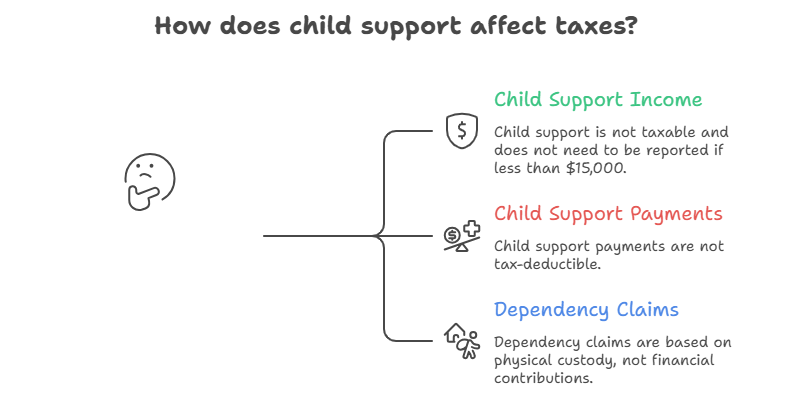
The IRS does not tax child support payments. IRS does not count child support as income. This has been the case for decades, and it remains so.
You don’t need to report child support if you received less than $15,000 last year. This amount is not included in your adjusted gross income and does not affect your eligibility for any income-based benefits or credits.
Child Support Payments are not tax deductible
It is also important to note that parents who pay child maintenance cannot deduct these payments from their income tax. Tax-deductible alimony payments used to be the norm before 2019, but this changed with the Tax Cuts and Jobs Act. Child support payments were never tax-deductible.
This is a reality that has frustrated many of my clients. The client pays $1,500 per month in child support and receives no tax benefit unless the child is claimed as a dependent on Form 8332.
Claim Children is Based on Custody and Not Money
IRS dependency claims are based on physical custody arrangements and not financial contributions. It can feel unfair for non-custodial families who pay a lot of their child’s expenses.
The system is designed on the assumption that parents who provide day-to-day childcare incur more costs. When you have children living with you for more than half of the year, it is easy to accumulate expenses such as housing, food, utilities and transportation.
Form 8332 is the only legal way to transfer tax claims
Divorced or separated parents who want to give the non-custodial child custody must fill out Form 8332. I’ve guided dozens of clients through this process and there are some critical details that many people overlook.
Form 8332: How Does It Work?
The custodial parents complete Form 8332 and specify which tax years or years are being released. The claim can be released for the current tax year, specific future years or all future years.
The IRS does not receive the completed form. The noncustodial parents attach the form to their tax returns. The noncustodial parents attach copies of the original forms each year if they are releasing the claim over multiple years.
What Does Form 8332 Do and Doesn’t Transfer?
The form 8332 does not transfer the right to claim Child Tax Credit or the dependency exemption. This form does not transfer eligibility.
- The Head of the Household status is filed by the custodial parent.
- Earned Income Credit (custodial parents keep this)
- Child and Dependent care credit (custodial parents keep this)
- Exclusion of dependent care benefits (custodial parents keep this)
Many parents overlook this important distinction. If you are eligible for the Earned income tax credit, even if your ex signs Form 8332 to claim dependency on you, you may still be able to file as the Head of Household.
Revocation of a previous release
You can reclaim a dependent if you have released your claim over multiple tax years. However, it will not be effective until after the tax year following the calendar year that you provided the revocation of the claim to the noncustodial parents.
If you withdraw permission in 2026, you will be able to claim the dependent on your 2027 return, filed in 2028. This was a lesson I had to learn the hard way when a client thought she could reclaim her kids immediately after her ex broke their custody agreement.
Parents make common mistakes with tax claims
In my twelve years of practice, I have seen the same mistakes repeated. These errors cost parents thousands of dollars in lost refunds, and cause unnecessary IRS headaches.
Both parents claim the same child
The IRS investigates when both parents claim the exact same child and awards the claim to the parent that had the child more nights in the past year. If the other parent’s claim is rejected, there may be penalties, and this entire process can delay both refunds.
This happened to me three years in a row because neither parent informed the other about filing taxes. The father who was not the custodial parent assumed that his divorce decree granted him this right. The mother who was in charge of the child assumed that her position as a parent gave her this right. Both were partly correct, but neither filled out Form 8332. This created an annual catastrophe.
Assuming Divorce Decrees Override IRS Rules
In your divorce decree, it may state that the noncustodial parents claim the children during even years and the custody parent claims them during odd years. The IRS is not concerned about the divorce decree.
No matter what the terms of the divorce agreement are, the custodial parents must sign Form 8332 before the noncustodial parents can claim their child. The IRS will not accept the claim if the form is missing. It may also assess penalties.
Do not confuse child support with dependent rights
You don’t have to pay child support in order to be able to claim your children. Receiving child maintenance does not disqualify you to claim them. The two are separate legal issues, regardless of what TikTok viral videos may suggest.
This distinction has been explained to me by a number of clients who think it is unfair that they are paying support, but not claiming the tax benefits. It’s fair to debate whether or not it is unfair, but the truth is that custody is what determines tax benefits, and not money.
What if both parents disagree about tax claims?
Many divorced families are tense because of disputes over who is entitled to claim the children. These conflicts are usually resolved in a similar way.
IRS Tiebreaker Rules
The IRS will use tiebreaker rules if both parents claim the same child, and both meet the criteria for qualifying children. The IRS treats the child as qualifying child for the parent who lived with the child the longest during the year.
The IRS will usually award the claim to the parent who has the highest adjusted gross income if the child lives with both parents equally. This scenario is not as common as people believe, because the majority of custody agreements do not split time 50/50 every year.
Court Ordered Arrangements
The court can include language about tax claims in the custody order. The court may order that the custodial parents sign Form 8332 in certain years or set up an alternate schedule.
Remember that IRS rules do not automatically override court orders. If the custodial parents does not sign and submit Form 8332 then the claim of the non-custodial parents will be denied, regardless of the court order.
The IRS will not take action if a parent refuses a court order that requires them to sign Form 8332, but instead, contempt proceedings can be brought in the family court.
Why this misinformation is so important
False statements about tax laws can cause real financial damage. Parents base their major decisions on what they think is true. These decisions can have serious consequences.
Parents I spoke to were afraid of losing their tax benefits. Some parents negotiated different custody agreements than they would have otherwise. Some even considered dropping all child support to keep their tax refunds.
In 2025, the Child Tax Credit will be worth $2,200 for each qualifying child. It can make or break financial stability in a family. Earned Income Tax Credit can add thousands to the refunds of low-income families. These are not small amounts.
It can cause panic among parents and lead them to make decisions that are not in their child’s best interest.
Recent Changes in Child Tax Credits
There is no Trump law on child support, but there are real changes in child tax credits that you should be aware of.
The One Big Beautiful Bill Act of 2020 made some modifications to the Child tax credit:
- Maximum credit increased from $2,000 per child to $2,200
- In 2026, the credit will be permanent and indexated to inflation.
- Both the child and the taxpayer must have a Social Security number
- Keep the thresholds for phase-out at $200,000 per single filer and $400,000 per joint filer
- Maintain the $500 credit for other dependents
The Child Tax Credit is estimated to benefit 23.8 million children, although those in lower-income households will see a smaller impact due to the refundability restrictions.
The changes are affecting all families with children. There are no changes to the child support recipients’ right to claim their own children.
Protecting yourself from Tax Misinformation
Many Americans rely on social media as their primary source of information, but they also use it to spread misinformation. How to avoid falling for false tax law claims.
Verify with Official Sources
Check IRS.gov or major tax professional associations, as well as reputable news sources, if you hear claims of new tax laws. All major changes to tax laws are published by the IRS, and reputable news outlets cover important legislative developments.
I bookmarked specific IRS pages to be able to quickly refer back when clients ask me about viral tax claims. Verifying whether something is fake or real takes only two minutes.
Be skeptical of dramatic changes
Tweets and social media updates are not enough to make major changes in tax laws. These changes require congressional action, lengthy debate and formal presidential signature. You should be skeptical if someone says a major policy shift occurred overnight.
The proposed Trump child support bill would have fundamentally changed how millions of Americans filed their taxes. This kind of change is not possible with a single executive order, but requires a substantial legislative process.
If you are unsure, consult a tax professional
Consult a tax expert or family lawyer if you are unsure of how the tax laws apply to your particular situation. Consultations are much cheaper than filing incorrect taxes or making decisions about custody based on inaccurate information.
I charge $200 per consultation to review the custody arrangements and their tax implications. This investment could save you thousands of dollars in IRS penalties or denied credit.
Frequently Asked Questions
There is no Trump child support tax law
The conclusion, after examining all credible sources, reviewing IRS documents, and consulting fact checking organizations, is clear: There is no Trump tax law that prevents parents who receive child maintenance from claiming children.
The claim that went viral was made up, its creator admitted it to be a fake, and does not have any basis in legislation or IRS policies.
Form 8332 is the only way to release this right. The child support payments are not included in this calculation.
When deciding on divorce, child custody, or child support, you should base your decision on the actual law and not what is being said in social media. Consult qualified professionals to review your situation and give you advice based on the current tax code and laws governing family.
Next time you read a dramatic statement about a new tax policy on TikTok, or Facebook take two minutes before you panic to confirm. You and your family deserve better than to be misled.