
QuantumRun vs BI Tools: Strategic Foresight Platform

A few years back, I was in a strategic meeting, listening to smart leaders make decisions based on the events of the last quarter. As they looked at the historical figures, Netflix was already disrupting the cable TV industry. Blockbuster executives also had historical information. They weren’t able to predict the future; they responded to it late.
Modern business realities demand something completely different. It is essential to know what’s to come before it’s here. QuantumRun Foresight Platform does exactly this. It’s not a business intelligence dashboard that is reusing the same metrics from yesterday. This is a strategic foresight system created for businesses that want to be the market leader instead of following them.
What is QuantumRun Foresight’s Platform Specifically?
QuantumRun Foresight is an intelligent strategic platform that blends the power of artificial intelligence with human knowledge and a proprietary method to detect emerging trends prior to them affecting your industry. The company functions as an expert consulting firm as well as a platform provider for technology that means you will receive the tools for software and access to analysis by experts. Imagine it as having a group of innovators experts working around the clock in the software platform that teaches the specifics of your industry’s dynamics.
The platform processes thousands of points in various dimensions: university research, patent applications, news sources, startups, consumer information as well as regulatory changes and technological advances. Instead of merely aggregating information QuantumRun’s AI analyses these signals to find patterns that aren’t visible to conventional market research. The system recognizes weak signals – early signs of significant changes in the near future, before they are apparent to competitors.
The business was founded on a certain belief that companies that can recognize trends and anticipate them gain massive competitive advantages, while those who react suffer from losing market share, credibility and even entire business lines. QuantumRun’s methodology was derived from the research of academic foresight, paired with practical experience in consulting with governments, corporations as well as investment firms across North America and internationally.
The importance of strategic foresight right today in 2025
The landscape of business changed more quickly in 2024, than in the entire year 2020. Artificial intelligence grew from the realm of academic research to the boardroom in just 18 months. Quantum computing was a transition from a theoretical perspective to commercial timeline discussions. Climate regulation moved from environmental concerns to a mandatory business plan. Companies that resisted these signals are in a state of panic. Companies that were anticipating these signals are now setting the direction of markets.
The truth is that the past’s data doesn’t tell you anything about the future. If Netflix was based solely on Blockbuster’s patterns for renting video and not been able to enter streaming. The data was available to show the growing popularity of internet-connected homes and changing consumer habits. However, traditional market research didn’t see the trend because researchers were stuck in the current assumptions of industry.
QuantumRun’s entire philosophy is based on this knowledge. The platform doesn’t just look at what your customers ‘ actions were yesterday. It determines how external forces are changing to shape what your customers want to buy, expect, and accept the day after tomorrow. Pharmaceutical companies that use the platform may realize the fact that artificial intelligence-led drug development has reduced time-to-market for its competitors, requiring them to overhaul their entire research pipeline. Financial services companies could realize that decentralized finance regulatory signals that will be coming in 2026 need creating a compliance infrastructure by 2025.
The stakes are high. Businesses that aren’t armed with trend intelligence don’t just miss opportunities. They’re in danger of disruptions they didn’t anticipate approaching until it was too late.
How QuantumRun Platform Effectively Functions The Three-Step Method

QuantumRun’s success is due to its simpleness encased in a sophisticated process. New users often expect complexity. Instead, they get simple interfaces based around three key actions that scale from individuals to large teams.
Step One: Curate Daily Trend Intelligence
Every day the platform will send you customized trends reports that are based on your market, industry and objectives of your organization. Contrary to general business news, these reports are derived from AI studying millions of sources and filtering them through filters you choose. The platform is partnered with the top news aggregators. They conduct deep analysis of patents, academic research and startup activities, as well as regulatory developments, and new signals.
It’s not easy to discern the information. You get curated information that the team actually cares about. An executive from the healthcare industry could observe trends in the regulatory environment for telehealth, AI diagnostic tools, startup companies in precision medicine, as well as the pressures to limit costs. Financial services strategists see the regulations for digital assets as well as embedded finance opportunities and changes in consumer preferences. The precise customization occurs because the algorithm identifies what is relevant to the specific goals of your strategy.
Step Two: Sort Your Insights into Actionable Collections
When your team is exposed to trends, you save relevant articles, research and reports on trends into individual lists. It’s easy until you realize that traditional research procedures involve scattered emails, lost notes and siloed knowledge that is shared across departments. QuantumRun’s collaborative curation ensures that everyone in the organization has access to the same trend libraries. Marketing can see what strategies have been discovered. Product teams gain insights from what product management discovered. Innovation groups make use of research and strategies for innovation.
The platform lets teams organize their research by tagging it in a variety of ways for industry, sector geography, subject region, time horizon with the potential for impact. This results in a structured knowledge management that turns scattered information into a collective knowledge.
Convert Research into Strategic Visualizations Instantly
This is the reason QuantumRun is a significant difference from traditional market research. Once you’ve put together trends research into custom collections The platform transforms the research into a series of actionable visuals specifically designed for strategic use.
Strategic Planner visualization Strategic Planner visualization uses SWOT analysis frameworks that are adapted to future scenarios. Instead of analyzing your internal strengths against the current threats and weaknesses, you evaluate the readiness of your organization in the face of future scenarios. What would your business’s competitive position be if this new trend is accelerated? What new threats are emerging? What opportunities do you see?
The VUCA framework visualization (Volatility Complexity, Uncertainty Ambiguity, Complexity, Volatility) shows trends in relation to the degree of disruption they cause and the degree to which their impact is predictable. Trends with high volatility require immediate plan of action. Uncertain trends require scenario exploration. Complexity indicators indicate how changes cause compound effects needing interconnected strategies.
The Innovation Grid is a 3D moveable visualization of the relationship between trends. It helps teams find unanticipated intersections. The team may find that trends in artificial intelligence and remote work evolution and shifts in preference between generations all come together to create a chance for centralized management of workforces completely different from the existing model.
The Market Segmentation visualizations will automatically divide the research into sectors geography, industry time horizon, probability, allowing teams to discern which trends are important to particular customer segments.
Who’s Really Using QuantumRun? Real-World Applications across Industries
QuantumRun’s client base includes the corporate strategy and innovation teams as well as investor analysis, research agencies and business development agencies. However, understanding the unique methods that different users use QuantumRun’s platform gives a clear knowledge of its value in the real world.
Corporate Strategy Teams utilize QuantumRun to develop mid-to-long-term strategic plans that incorporate disruption. Instead of creating five-year plans that are based on linear projections of trends in the market and scenarios, they create them around probable futures. Collins Aerospace uses the platform to determine the direction of change in the aviation industry years ahead, which allows strategic investments in the latest technologies. This transforms the strategy from reactive adjustments into proactive position.
Innovation and Product Teams leverage the platform to brainstorm ideas for new products and roadmaps for development. Instead of building on the existing product, they investigate potential opportunities for innovation arising from trends intersections that the platform detects. A product manager working in a highly competitive B2B market identified new trends within the African market via QuantumRun directly influencing the priorities for product development and go-to-market strategy. Innovation is moved from internal brainstorming into evidence-based opportunities evaluation.
Investor Research Teams and venture capital professionals utilize QuantumRun to find potential opportunities for startups and signal signs of disruption before they become apparent to the general public. It helps investors identify emerging areas, recognize the startups that are best placed to profit from trends and identify what trends represent real disruptions as opposed to hype cycles. More than 3,000 strategists and investors are currently using QuantumRun predictions to predict startups’ opportunities.
Government and Policy Teams use QuantumRun to help with policy development as well as planning resource allocation. In the case of Colorado Hospital Association, Colorado Hospital Association used the platform to investigate the possibilities of telehealth and workforce management options that could transform the way healthcare is delivered in Colorado. Government agencies employ similar strategies to plan infrastructure as well as funding for science and technology and public expenditures with long-term effects.
Marketing and Customer Insights Teams use the platform to anticipate shifts in consumer preferences prior to them manifesting in purchase behaviors. Instead of waiting for market research from the past to show what consumers want now Marketing leaders can predict shifts in preferences and plan campaigns to reflect this.
What makes QuantumRun Different from Competitors Like Tableau, SAP, and other BI Tools
The difference in QuantumRun as well as traditional intelligence for business is vital since the majority of organizations are confused. Tools for business intelligence like Tableau, Power BI, and Looker excel at one thing: turning historic data into easily understood visualisations. They’re excellent at analyzing what is happening. However, business intelligence cannot forecast the future since it is based on historical patterns.
QuantumRun is in a different class entirely called strategic foresight. The difference is important because the approaches diverge in. Tableau is a data storage system that connects directly to the warehouse and displays patterns. QuantumRun is able to connect to external signals – industry developments, new technologies and regulatory signals, as well as changes in consumer behavior–that can help you predict the future of your business.
In comparison to other traditional business intelligence rivals QuantumRun gives:
External Signal Processing Tools: These tools analyse internal data. QuantumRun examines trends and external signals technology, startups regulations, consumer signals that are transforming your industry. It’s impossible to predict disruptions through analyzing internal operational information. External warning signals and threats.
The Foresight Methodology QuantumRun employs a strategic framework for forecasting that integrates scenario planning, trend synthesizing, and macro driver analysis disruptor radar. These are both academic and consulting disciplines specifically designed to predict future events. Tools for BI use methods of visualization and statistical analysis specifically designed for analysis of historical data. Different problems require different approaches.
AI with Expert Validation: The platform combines the efficiency of algorithms by identifying patterns among millions of sources, and human skilled validation to separate signals from noise. The majority of BI tools automatize everything. QuantumRun recognizes that signals of importance require skilled interpretation. Patent filings show the possibility of technological advancement. However, experienced analysts of foresight can tell which patents are real breakthroughs, and which ones are incremental.
Industry-specific customization: QuantumRun tailors trend intelligence to specific industries and goals. Healthcare companies receive the latest trends in healthcare. Financial services companies receive financial signalling of innovation. Manufacturing companies are aware of industrial, automotive and supply chain trends. Business intelligence dashboards that are generic provide you with everything in one place. QuantumRun will show you what is important to your particular future.
Software for planning scenarios: More than dashboards that show historic metrics, QuantumRun’s visuals assist teams in analyzing “what is the case” scenarios. If this trend is to increase how will it affect the way we conduct business? If multiple trends intersect to create a competitive advantage, what’s our standing? This helps build organizational resilience and prepares them for the future, not an illusion of confidence in the historical patterns.
If you compare them to particular rivals, the differences are clear:
Versus Varo: Varo focuses on marketing analytics and provides customer insight from their past behaviour. QuantumRun provides future-facing strategic intelligence.
In contrast to Allstacks: Allstacks focuses on operational metrics and business metrics. QuantumRun is focused on trend external analysis and strategic forecasting.
The Redash Versus Redash: Redash provides data visualization and dashboards of business intelligence. QuantumRun offers strategic foresight as well as tool for planning scenarios.
The real-world implications is: don’t use QuantumRun to substitute BI tools. It is recommended to use both. The BI tools will let you know how you did yesterday. QuantumRun will tell you what your environment will be like in the future. Both are important.
How do I Actually Begin The Practical Implementation Guide
QuantumRun intentionally develops their onboarding to be user-friendly. The platform can train the new team in under 30 minutes since it adheres to user-friendly guidelines rather than the enterprise’s complexity. Implementation is quicker than the majority of enterprise software.
Phase One: Review Your Strategic Questions
Before you sign up for the platform, you must define the things you’re looking to learn about the future of your business. It’s easy to pinpoint a few key questions affecting your business strategy. “How do we expect AI to change our landscape of competition?” “What regulations will change our business model over 3 years?” “Which segment of customers are likely to emerge as the most beneficial?” The answers to these questions will help you focus your research and help make findings useful.
Phase Two: Set Up Your Trend Then, Focus
Onboarding, you will specify your industry, geographical markets, as well as specific topics or sectors that match your strategic needs. The platform makes use of these filters to tailor daily trends reports. If you’re a retailer, you will get insights into the behavior of consumers, e-commerce, automatization, supply chain and innovation in retail. If you’re in the healthcare industry you’ll see trends in technological advancements in healthcare and regulatory changes, as well as the use of precision medicine, as well as policies that are changing.
Phase Three Training Your Team Members on the Three-Step Workflow
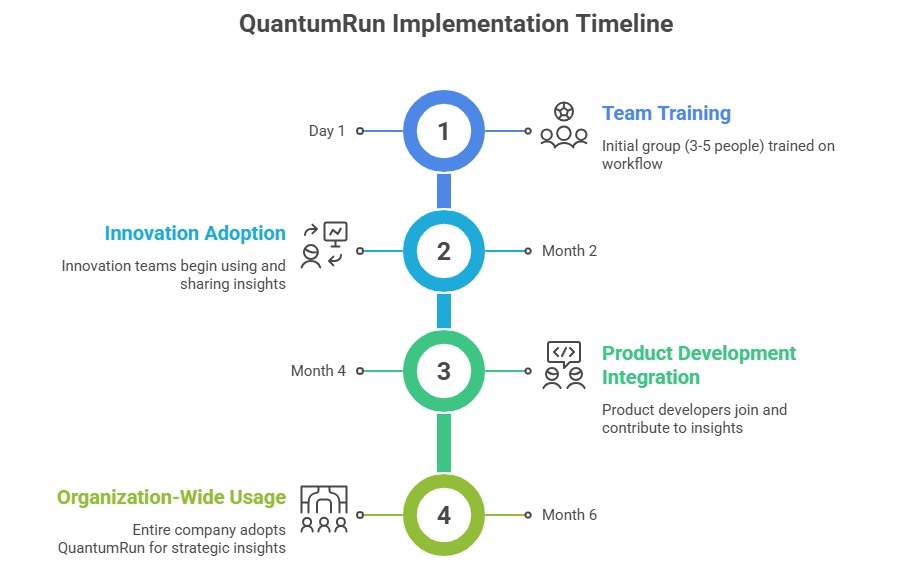
The majority of organizations train their initial group (3-5 people) in a day. The early adopters teach larger groups. The process is the same every day: spend between 15 and 30 minutes reviewing the latest trends in your collection, save pertinent information from your personal collections, and then occasionally create visualizations that convert collections into strategic information.
Phase Four: Begin small, scale across departments
Initial implementations typically are focused on the strategy group or innovating groups. These teams produce insights and share them with the company, and show the value. In a matter of 3-6 months, the majority of companies expand to teams for product marketing, business development and ultimately the executive leadership.
Real-time scale: one company observed adoption beginning in the strategy, grow to innovation within a matter of two months, join teams of product developers in just four months and then achieve the entire organization’s usage in six months. Each expansion occurred because people recognized the value other people brought to their work.
The real benefits What Benefits Do Organizations Really Gain by implementing QuantumRun
Beyond the theoretical benefits of strategic foresight, companies who use QuantumRun provide concrete results.
Rapid Strategy Development In lieu of planning strategic cycles that last three years built on assumptions, businesses design strategies that are flexible, taking into account various possible futures. This enables faster strategic pivots as trends change. Businesses report a reduction of 40-60% in the time they spend on research into trends and market research analysis due to QuantumRun reducing the need for hiring consultants or managing massive research teams.
Innovative Acceleration: Teams from the product industry have reported that trend intelligence speeds up the process of innovation for products that address emerging opportunities. Instead of internal brainstorming, teams look for the gaps in markets that emerge from trends analysis. One organization claimed to have reduced the time to develop new products by 25% thanks to improved market intelligence. Another company identified a totally new business area based on trends intersection analysis that they would not have found through internal brainstorming.
Effective Strategic Decisions: Managers take strategic decisions based on more evidence of future conditions. The investments in new technologies are aligned with the trend trajectory instead of speculation. Market expansion plans are influenced by regulatory developments as well as competitive positioning trends and consumer trends. It’s not a guarantee of perfect foresight, as the future isn’t certain. But it greatly enhances the quality of decision-making in comparison to decision-making that is based on assumptions.
The Early Warning System helps companies detect disruption signals before. A company that sells consumer goods realized through QuantumRun that the health-conscious lifestyle of consumers and the personalization trend in technology are convergent to offer opportunities for personalized nutritional products, which allows the company to create products and capabilities ahead of competitors. Automotive suppliers recognized the acceleration signals of autonomous vehicles prior to traditional market research, which allows an effective positioning in what will soon be a dominant market.
Competitive Advantage through Foresight: Businesses that are aware of disruption have the advantage of strategic planning. They are able to build capabilities, recruit people, create alliances, and position their products ahead of their competitors. It’s not a guarantee, but it’s significant when you consider the ability to detect disruptions before they have already affected your company.
Team Alignment Around Future It is often overlooked, QuantumRun creates shared understanding of the future for all organizations. When product, strategy marketing, innovation teams are all able to see the same trends and align themselves around the same expectations for the future rather than divergent internal views. This reduces friction within the organization and speeds up collective decision-making.
Pricing, Plans, and Choosing the best fit for your Organization
QuantumRun has tiered pricing that reflects the size of teams and requirements for customization. From 2025, the system will offer three pricing models.
Business Plan designed for teams with 5-20 members Business Plan includes daily reports on trends that are curated and curated as well as access to visualization tools, as well as multi-user collaboration tools. The cost typically ranges between $400 and 600 monthly, but can vary based on the specific support and customization requirements. This type of tier is ideal for product teams, innovation teams, or even strategy teams within mid-market companies.
Enterprise Plan: Designed for companies with more than 50 users across several departments The Enterprise Plan provides unlimited user accounts, access across the organization to custom reports that are tailored for you and priority assistance. Enterprise pricing is based on the ability to customize and is usually agreed upon directly. The majority of enterprise implementations cost $10,000 to $30, 000 per year according to the extent, customization, and the support provided by consultants.
Consultant Services QuantumRun offers consulting and support that go beyond access to the platform. A dedicated foresight analyst working every day for research and analysis is typically paid between $3,000-5,000 per month. Consulting for full projects varies greatly in relation to extent. Companies that use both consulting and platform-based services see more ROI than platforms that only use them since consultants assist teams in gaining maximum value from trends intelligence.
The real truth: QuantumRun isn’t cheap compared to the basic tools for business intelligence. It’s a completely different value. There’s no need to pay for dashboards that display your data. You’re paying for a warning systems to detect disruption before it affects your business, and expert advice on how to interpret emerging trends.
When evaluating affordability, companies should think how much it will cost to avoid not being able to spot a major change in your sector. What’s the worth of identifying an opportunity in the year prior to competitors? What’s the advantage when you know your future’s environment more than the majority of competitors?
The majority of companies recoup their investment within their first strategic decision, aided by QuantumRun intelligence. They either steer clear of a costly error by identifying the signs of a trend warning against investing or making an investment in a promising opportunity earlier than their competitors. Both scenarios result in ROI that is greater than the cost of the platform.
Common Challenges and how organizations actually overcome them
Companies that implement QuantumRun face predictable issues that are important to understand prior to deploying.
Challenge One: “Too Much Information”
The first time users are overwhelmed by the daily reports on trends and the data available. The solution is quick. Do not encourage staff members to study every single word. Instead, you should train them on strict filtering. Make sure you bookmark only the trends that directly answer your questions about strategy. Do not look at anything else. The majority of companies improve curation in two weeks and discover that they’re reviewing 15 quality patterns per day rather than hundreds of trends.
Second Challenge: “We Don’t Know How to Make Use of This Information”
Companies that have experience with historical data analysis may have trouble translating trends that are geared towards the future into a strategy. This requires a shift in the way they think. Instead of asking “What does this data show in the present?” Instead, ask “What does this data tell us about the future?” It’s not obvious, but it’s an enormous cognitive shift. QuantumRun’s consulting expertise is excellent in aiding organizations in this transition.
Third Challenge “Executive Skepticism Regarding Foresight”
Sometimes, executives dismiss trend information as speculative. Be able to prove accuracy in forecasting over time. Monitor which trends QuantumRun discovered that later came to fruition. The majority of companies find that 70 to 80 percent of the trends identified affect their businesses within a couple of years. However, unexpected trends account for between 20-30% of the disruptions to organizations. This record establishes credibility.
The Challenge 4: “Organizational Inertia”
Not all disruption signals alter behavior. Companies continue to follow their old strategies even when they are aware of the threat that is emerging. The solution is to link the trend intelligence with formal strategies. Link quarterly trends reviews to the strategic plan cycles. Include trend analysis in assessment of market opportunities and competitive evaluations. Incorporate foresight into normal decision-making instead of an external source of information.
The Challenge 5: “Integration With Existing Tools”
Companies ask if QuantumRun is compatible with the existing BI platforms CRM systems, BI platforms, or other project management tools. QuantumRun has APIs and customizable integration options for clients of enterprise. But, the platform can be used effectively as a stand-alone application. The majority of organizations don’t integrate extensively and instead use QuantumRun insights to help inform information in other systems, instead of trying to integrate technical aspects.
The Main Point What QuantumRun is and why it’s important now More Than It’s Ever
Blockbuster has historical data that shows the demand for video rentals. They couldn’t have predicted Netflix disruption since they looked at rent patterns in the wrong way rather than external indicators of change in behavior. Kodak created digital photography, but they didn’t realize it could affect their primary business. The companies were able to draw on experts, skilled employees as well as a vast database of details. They didn’t know what was to come.
QuantumRun is created to stop this specific type of failure. It gives companies the ability to see disruptive signals before competitors can see them. It helps organizations think through multiple possibilities for futures instead of relying on the linearity of current trends. It helps create a shared understanding among teams of what’s happening within your business’s competitive landscape.
The year 2025 is the time to realize that operating without the strategic horizon isn’t just unoptimal. It’s reckless. Your competitors are looking for signs of disruption. The market is shifting more quickly than the patterns that historical trends follow. The preferences of your customers change in response to external forces that aren’t able to predict based on past behavior alone.
QuantumRun put you in a position to see the future ahead of time. The position is strategic which is well worth your investment. Organizations that adopt strategic foresight now will be the ones creating their industries for 2027, and even beyond. If they wait, they’ll react to changes that they didn’t anticipate.