
IRS Mileage Rate 2025: Complete Guide to Standard Rates, Calculator
What is the IRS mileage rate for 2025
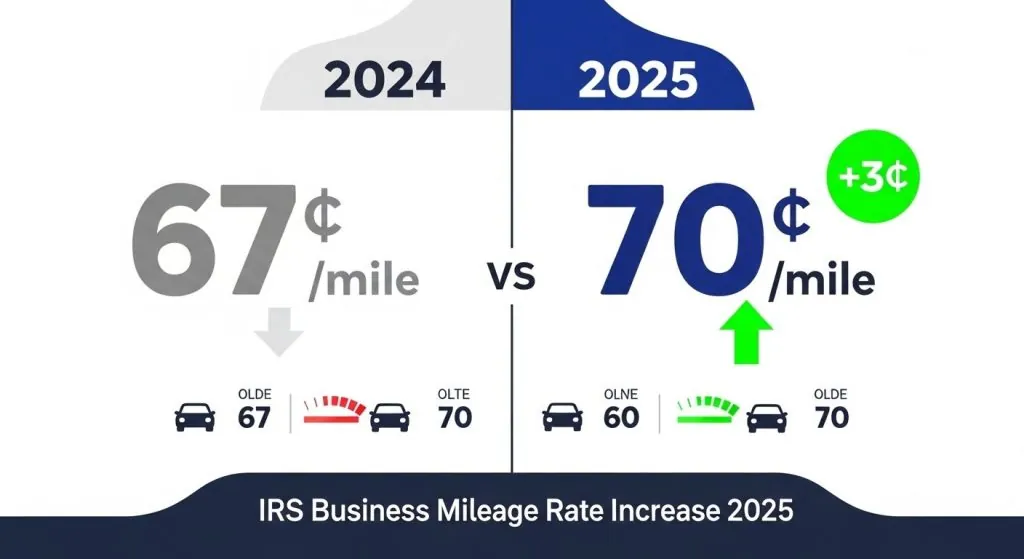
The IRS will allow you to deduct an amount per mile if you drive your car for charity, work or medical appointments in 2025. You won’t have to track every receipt. This amount is known as the standard mileage rate. For 2025, IRS increased the rate for businesses by 3 cents, which was the largest single-year increase since the mid-year adjustment during the pandemic era.
This article will tell you everything about the 2025 IRS Mileage Rate, including who is eligible, how to calculate the deduction, the changes from 2024 and the comparison of rates between the US, Canada UK, New Zealand and Australia.
Learn More, AT&T Data Breach Settlement Claim
IRS 2025 Standard Mileage Rates in a Glimpse
| Purpose | 2025 Rate | Rates for 2024 | Changes to the Law are Coming Soon |
| Business (Self Employed, Small Business) | 70C//mile | 67C//mile | +3C/ |
| Medical Treatment | 21C//mile | 21C//mile | No Change |
| Military (Active duty Moving) | 21C//mile | 21C//mile | No Change |
| Charitable Organizations | 14C//mile | 14C//mile | No Change |
Source: IRS Notice No. 2025-5. Internal Revenue Service. January 1, 2025
The increase in the business mileage rate from 67 to 70 cents per kilometer reflects increasing vehicle ownership costs, including fuel, insurance and depreciation. Congress has set the charitable rate at 14 cents a mile. This cannot be changed without new legislation.
How much can you deduct from your IRS mileage rate?
You don’t need to use a complex spreadsheet. Here is a simple formula that the IRS uses.
Total Miles Driven x Applicable Rate = Your Deduction
Real-World Calculation Example:
Example 1 — The Self-Employed Entrepreneur:
- Total business miles by 2025: 12,000
- Rate: 70 cents/mile
- Deduction: $8,400
Example 2 — Medical Travel
- Miles driven for doctors, hospitals and treatment: 2,500
- Rate: 21 cents/mile
- Deduction: $525
Example 3 — Charitable Volunteer:
- Miles driven volunteering for a nonprofit: 1,800 miles
- Rate: 14 cents/mile
- Deduction: $252
Example 4 — Gig Economy Worker (DoorDash, Uber, Instacart):
- Total delivery miles: 18,000 miles
- Rate: 70 cents/mile
- Deduction: $12,600
Tax deductions of $700 per 1,000 miles of business travel are available at 70 cents a mile. This can add up quickly for workers who travel a lot.
What is the IRS mileage rate 2025? (Gas, Depreciation, Breakdown)
It is also one of the most frequently asked questions. The IRS includes the following in the standard mileage rate:
Fuel and gasoline costs
Depreciation of vehicles (included in the rate)
Oil changes and routine maintenance
Insurance premiums
Tire replacement costs
Registration fees (partially).
What the rate DOES NOT include:
Parking Fees (deductible separately).
Toll charges (deductible separately).
Interest on a loan for a vehicle (partially deductible by self-employed people)
Personal car wash and cosmetic repairs
IRS Depreciation Rate for 2025: The standard mileage rates include a depreciation component. The depreciation component for 2025 is about 30 cents per kilometer, which lowers the tax basis of your vehicle. It is important to know this when you decide to sell your vehicle.
Who is eligible to use the IRS standard mileage rate 2025?

Self-Employed Workers & Independent Contractors
You can deduct your business mileage at 70c per mile if you use Schedule C. This includes freelancers and consultants, as well as real estate agents, travelling nurses, sales representatives, and those who run their own businesses.
Small business owners
Businesses that use their personal vehicles to conduct client visits, site surveys, supply runs or business errands are entitled to the full 70 cents a mile rate for business miles.
Gig Economy Workers
Uber, Lyft and Amazon Flex drivers benefit from this deduction. Every mile you log for a platform business could be worth up to 70 cents when it comes time to file taxes.
Medical Patients
The medical mileage rate is 21 cents per kilometer for doctor’s appointments, specialist visits or hospital stays. But only the portion of your income that exceeds 7.5%.
Charitable Volunteers
You can deduct 14c per mile if you drive to volunteer for a 501(c),3 nonprofit recognized by the IRS.
Active Military Members
The military personnel who are on orders to move permanently can claim a mileage deduction of 21 cents per mile.
Regular W-2 employees
Tax Cuts and Jobs Act 2017 prohibits W-2 employees from deducting unreimbursed miles on federal returns until 2025. This deduction is still allowed in some states, such as California and New York.
IRS Mileage Rate for Nonprofits 2025
The rate for using your vehicle to do charitable or nonprofit work is 14 cents a mile. This rate applies to:
- Driving to a non-profit organization to volunteer
- Transport of supplies for a charity event
- Meals-on-wheels delivery volunteers
- Charity activities related to the church
Important: The IRS does not set this rate. Congress does. For it to be changed, Congress must act.
US vs. Global Comparison of 2025 Mileage rates Global Comparison
Users often search for the mileage rates of different countries. The US 2025 rate is compared to other countries.
| Country | Agency | Rates for 2025 | You can also find out more about Currency |
| USA (Business) | IRS | 70C//mile | USD |
| USA (Federal/GSA) | GSA | 70C//mile | USD |
| Canada (CRA) | CRA | 72C//km (first 5,000km) | CAD |
| United Kingdom | HMRC | 45p/mile (first 10,000) | GBP |
| New Zealand (IRD). | IRD | $0.21/km | NZD |
| Australia (ATO). | ATO | $0.88/km | AUD |
State-Specific Notes:
Mileage Rate California 2025
California Labor Code Section 28002 requires employers to reimburse their employees for all business expenses including mileage. California uses the IRS rate (70C//mile) as a guideline, but employers are allowed to use a higher one. California employees can still claim mileage on their state tax returns, even if it is not allowed on federal returns.
Mileage Rate for 2025 Texas
Texas does not have a state income tax. Therefore, state mileage deductions are not applicable. Self-employed Texans deduct their federal Schedule C deductions at the federal IRS rate, which is 70 cents per mile.
Mileage Rate 2025 Michigan:
Michigan follows IRS guidelines. For self-employed filers who use Schedule C, the standard mileage rate for Michigan in 2025 will be 70 cents a mile.
Mileage Rate 2025 Illinois:
Illinois workers use the IRS standard mileage rates. Illinois employers often use the GSA’s 70-cent-per mile mileage rate as a benchmark when determining employee reimbursement policies.
GSA Mileage 2025: What Federal employees Need to Know
General Services Administration (GSA), the federal government’s mileage reimbursement agency, sets the rate. The GSA rate will mirror the IRS business rate in 2025.
GSA POV (Privately owned Vehicle) Mileage rate 2025: 70 Cents per mile
This rate is applicable to federal employees who use their own vehicles for official government business travel. This rate applies to:
- Travel for federal contractors approved
- Temporary duty of government employees
- Workers from civil agencies using their own vehicles
Which method will save you more in 2025: Standard mileage rate or actual expense method?
When claiming vehicle expenses on your tax return, you have two options:
Option 1: Standard Mileage rate (70C/mile).
- Multiply the miles by the rate
- Best for: Drivers with high mileage, drivers of fuel-efficient cars, and new drivers to deduction
- You must choose the option in the first year that you use your vehicle for business.
Option 2: Actual Expenses Method
- Simple: Track all expenses (gasoline, oil, insurance, repairs, depreciation).
- The best for: High-priced vehicles, low-mileage vehicles that are expensive, and vehicles with a significant depreciation.
- Requirements – Must keep track of ALL vehicle expenses and provide receipts
Rule of thumb: If you drive over 15,000 miles in a vehicle that is average for business, you will get a bigger deduction if you use the 70-cent standard mileage rate. Before filing, run the numbers in both directions.
IRS Mileage Recordkeeping requirements 2025: What your log must include
If you can’t prove your mileage, the IRS may disallow it. According to IRS Publication 463, your mileage log should include:
Dates of each trip
Destination (city, address)
The purpose of your trip should be business-related
Miles driven per trip
Total readings of the odometer (at start and end of the year)
Best mileage tracking apps for IRS compliance in 2025
- MileIQ — Automated tracking and IRS-compliant reports
- Everlance – Best gig worker app
- Driver’s note — Automatic detection and GPS verified
- TripLog — The best for small businesses
- Stride — Great app for freelancers, and it’s free!
The IRS requires receipts in most cases for expenditures over $75. The IRS does not require receipts for mileage. Instead, it requires a contemporaneous log of mileage regardless of how much you spend. It is important to record each trip as it occurs, and not months later when it comes time to file taxes.
Can I Reimburse 70 Cents per Mile?
Yes, 70 cents per kilometer is considered to be a good reimbursement rate in 2025. Here’s the context:
- The average cost of owning and operating a vehicle in 2025 in the US is $0.72 to $0.85 per mile. (AAA data).
- The IRS rate of 70 Cents covers the actual cost for most vehicles
- The deduction may be profitable for high-efficiency vehicles because 70 cents of your actual costs could exceed the real cost.
- Actual costs for luxury or large trucks may exceed 70 cents. This makes the method of actual expenses more advantageous.
The IRS has approved a rate of 70 cents for reimbursement. This means that the reimbursement to an employee is not taxed under a plan with accountability.
What is the IRS mileage rate for 2026? (Early Outlook)
Analysts and tax professionals predict that the IRS mileage rate in 2026 will remain at or slightly above 70 cents a mile depending on:
- Gas prices to average in 2025
- Trends in vehicle insurance costs
- Federal Reserve interest rates impact on vehicle financing
- AAA and Industry Vehicle Operating Cost Studies
In November or December, the IRS announces the mileage rates for the next year. IRS Notice 2025XX will be published later this year to announce the official 2026 rate.
History: In four of the five years since the IRS increased the rate for business mileage, the IRS has done so. If fuel prices remain high, a rate of 71 to 73 cents per miles in 2026 is reasonable — but not guaranteed.
The 2025 Mileage rate: Frequently Asked questions
Q: What will the new IRS mileage rates be for 2025
Effective January 1, 2025, the following rates will be in effect: 70 cents a mile for business, 22 cents if you are a medical or military personnel, and 14 cents if you’re donating your time to charity.
Q: Will the IRS mileage rate increase in 2025?
A: Yes. The rate for business increased by 3 cents from 67 cents to 70 cents.
Q: Does the IRS mileage tax include gas?
A: Yes. The standard mileage rate includes depreciation costs, insurance, maintenance, oil and gas.
Q: What is 75 percent rule?
A: For business expenses exceeding $75, the IRS requires documentation. However, for mileage, it is required to keep a contemporaneous record regardless of the amount.
Q: Can employees on W-2 forms deduct mileage after 2025?
A: No. Not on federal tax returns. California and other states allow this deduction on a state-by-state basis.
Q: Does 70 cents per mile represent a good reimbursement?
A: Yes. The IRS approved rate is based on the average cost of a vehicle and closely reflects actual costs.